
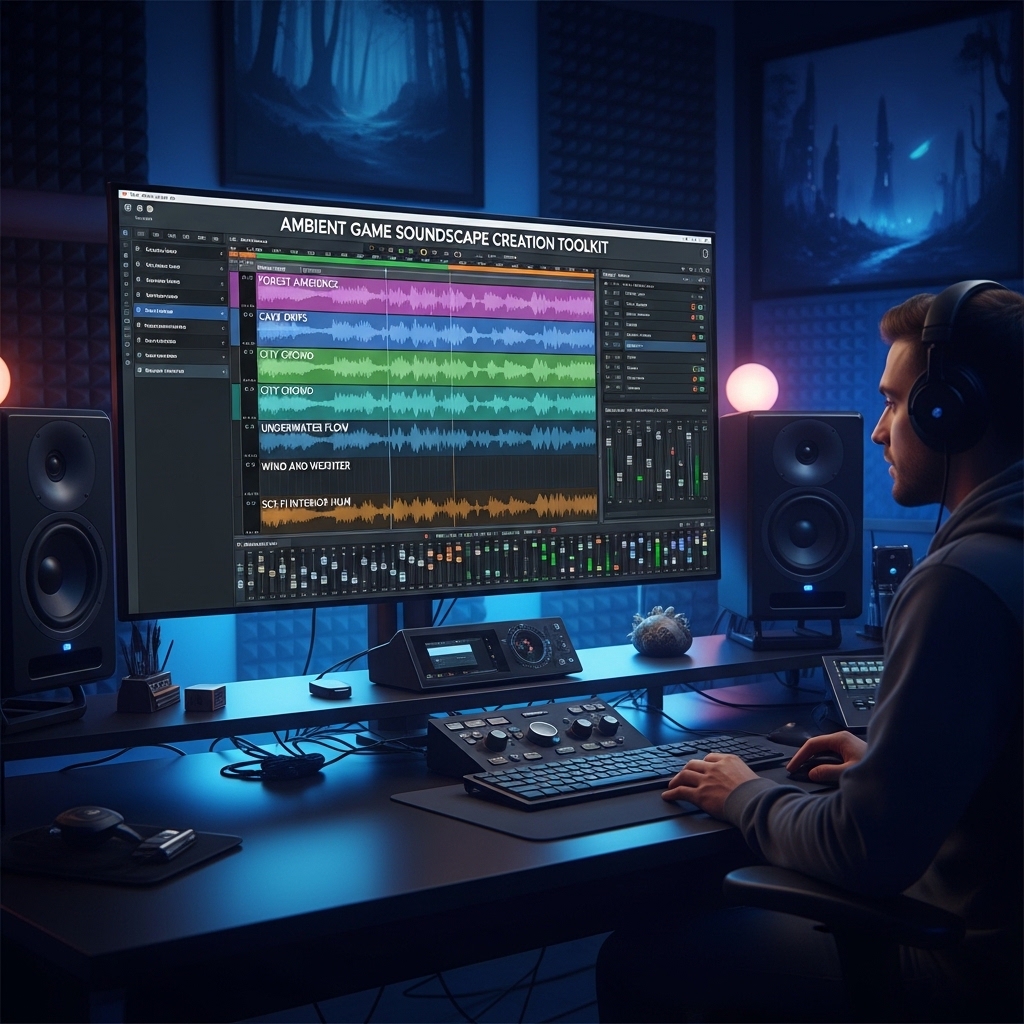
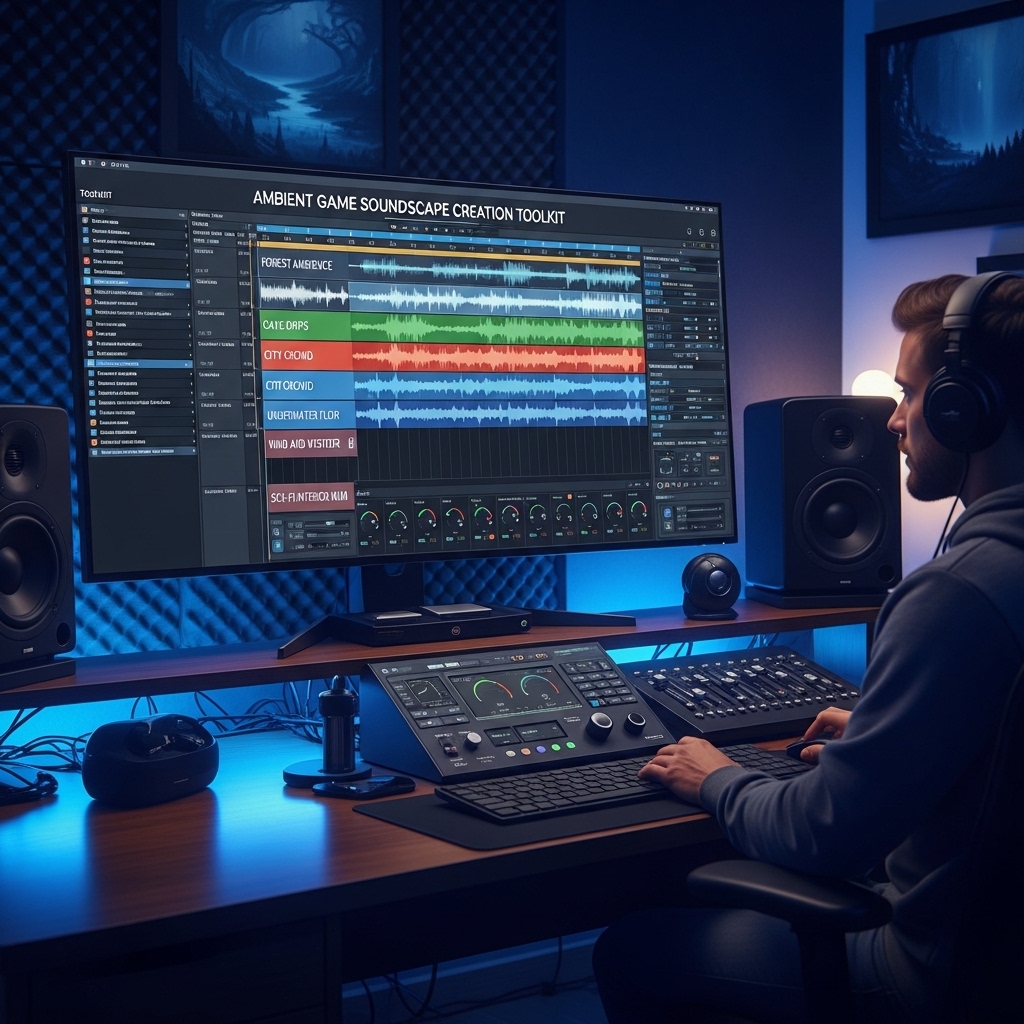
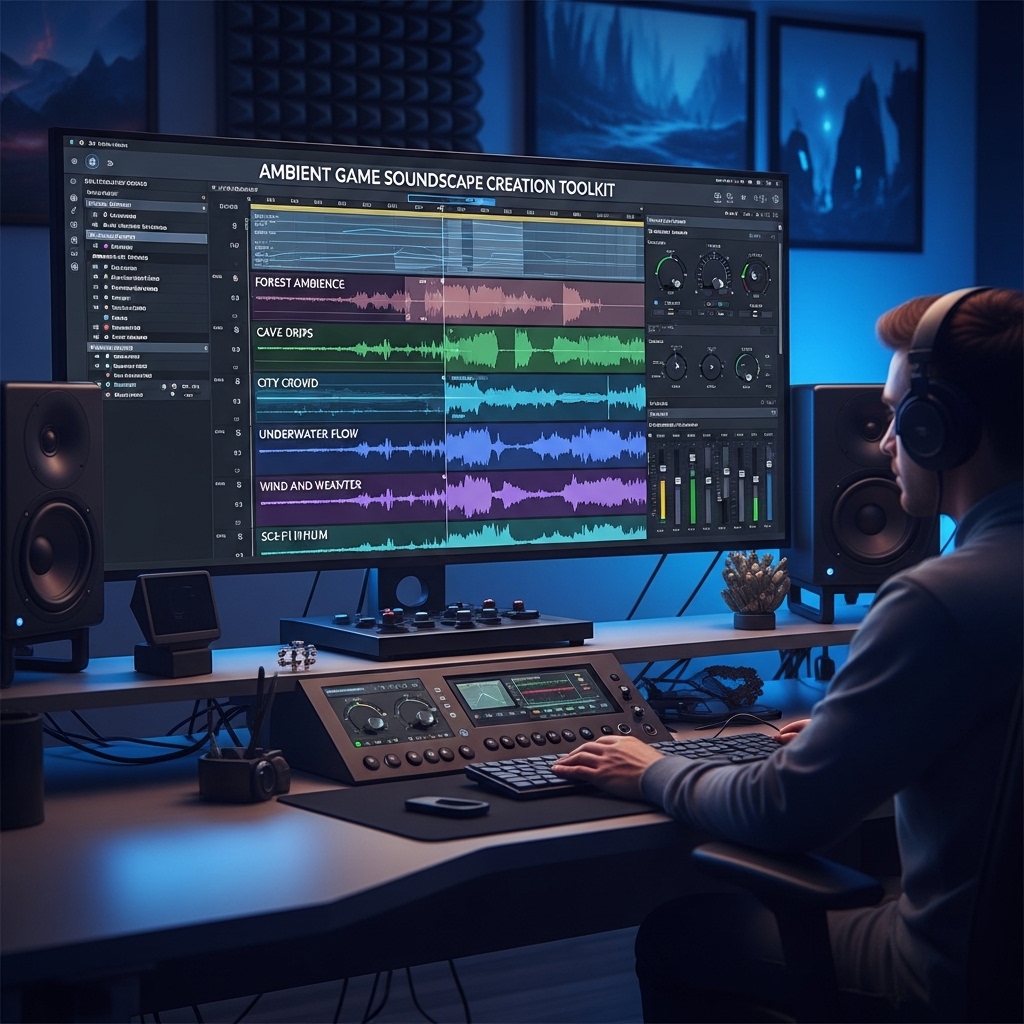
Ambient Game Soundscape Creation Toolkit
300 Layered Environmental Audio Assets for Building Immersive Game World Atmospheres
Silence in a game is not the absence of sound. It is a design decision — and usually the wrong one.
The moment a player enters a cave and the music stops — they are aware of the cave in a way that a layered cave soundscape would never produce. The water drip that appears irregularly. The distant echo of wind through a deeper passage. The creak of unstable rock. The subtle hum that might be the cave’s natural acoustics or might be something alive further in.
None of these sounds are music. None of them are dramatic. All of them are doing invisible work — maintaining the feeling of a lived-in, physically real world that exists beyond the edges of the screen.
This toolkit is the library for building that world. Not the music — the texture beneath the music. The environmental layer that the player absorbs without noticing and feels immediately when it is removed.
📥 Instant digital download. 300 layered audio assets. Available immediately.
THE TOOLKIT — BY ENVIRONMENT TYPE
🌿 NATURAL EXTERIOR ENVIRONMENTS (72 ASSETS)
Forests and Woodlands (18 assets) The complete forest layer system: the base forest ambience with wind through canopy at three intensities (calm, moderate, gusty), the bird and wildlife layer in three densities (sparse, moderate, busy), the insect layer for summer/tropical forest, the rain layer in three intensities (light rainfall, moderate rain, heavy rain), and the specialized variants: the dense rainforest (the humidity and density of subtropical canopy), the dead/winter forest (the absence of bird life and the particular silence of bare branches), and the haunted/cursed forest (the same structural layers with subtly wrong tonal qualities — the subliminal unease without obvious monster sounds).
Outdoor Water (14 assets) Stream variants from trickle through babble through rush, the river with current, the waterfall at three scales, the ocean shore at three states (calm lapping, moderate waves, storm surf), and the lake in still conditions — the particular silence of calm open water.
Open Terrain (16 assets) The plains wind loop, the grassland with insects and birds, the mountain summit (the thin wind and the vast silence of high altitude), the desert at three times (day — heat shimmer and distant sand movement, dusk — the transition stillness, night — the surprising activity of desert fauna), and the tundra.
Sky and Weather (24 assets) Rain loops at six intensities from drizzle through torrential downpour, thunder textures (the distant roll, the medium approach, the close crack, and the overhead), the storm environment (rain plus wind plus thunder combined layer, three intensities), the fog environment (the acoustic dampening effect of fog plus the particular silence it creates), and the snow environment (the cushioned quiet of a snowfield, the wind-driven blizzard). 🌧️
🏚️ INTERIOR AND ARCHITECTURAL ENVIRONMENTS (68 ASSETS)
Dungeons and Underground (22 assets) The cave drip system (the single irregular drip, the multi-drip cave, the water flow underneath stone), the cave echo and reverb room tone (small chamber, medium chamber, large cavern, vast underground space), the dungeon corridor (torch crackle present in three intensities), the ancient dungeon (the layer that communicates age — dust, stillness, the sense of abandonment), the flooded section, the collapsing instability layer (falling pebbles, creak, the held-breath quality of structural danger), and the underground lake room tone.
Abandoned and Derelict (18 assets) The empty house (the subtle creak of settling structure, the distant wind through broken windows), the abandoned facility (the hum of failed lighting, the drip of pipe failure, the industrial ghost), the sunken or flooded interior, the fire-damaged building (the smell of char communicated in audio through the particular crackling of dying embers and the odd acoustic of burned-out rooms), and the haunted space (the ambient that communicates presence without stating it).
Occupied and Living Spaces (18 assets) The tavern ambience (the murmur of conversation, the cutlery, the fire, three crowd density levels), the marketplace (the busy chaos of commerce and street life), the library (the near-silence of scholarship and turning pages), the throne room or grand hall (the particular echo of large ceremonial spaces), the temple interior, and the forge (the fire, the metal, the productive industrial rhythm). 🏰
Mystical and Supernatural Interiors (10 assets) The portal room hum, the magical workshop (the subtle ambient of enchantments in progress), the crystal cave (the ethereal resonance of mineral formations), the astral space ambience, and the void room — the sound of nothing in a way that communicates the nothing is intentional rather than empty.
🚀 SCIENCE FICTION AND FUTURISTIC ENVIRONMENTS (62 ASSETS)
Space and Vessel Interiors (26 assets) The spaceship engine room (the constant deep vibration of propulsion, three power levels), the spaceship bridge (the electronic activity of a crewed navigation space), the ventilation system (the breath of life support — the constant that indicates function), the coolant system, the gravity generator, the ship on emergency power (the particular quality of reduced systems and alert states), the derelict ship (the failed state of the same systems), and the observation deck (the near-silence of space with subtle structural vibration).
Alien Environments (20 assets) The alien forest (natural sounds through the processing filter of the biologically strange — familiar structure, fundamentally wrong frequencies), the crystalline cave (the resonance of an inorganic growth environment), the alien ocean shore, the alien atmosphere (wind with the tonal quality of a different molecular composition), and the alien underground.
Technological Spaces (16 assets) The server room (the computational hum and cooling infrastructure of processing power at scale), the laboratory, the factory floor at three production rates, and the clean room (the acoustic treatment of the sterile and controlled). ⚙️
🌆 URBAN AND CIVILIZED ENVIRONMENTS (54 ASSETS)
Exterior Urban (24 assets) The city ambience from quiet street through busy thoroughfare through rush hour, the market district, the harbor/dockyard, the construction site, the night city (the particular population of the urban dark — fewer cars, different voices, different life), and the post-apocalyptic city (the absence of what should be there, filled by what should not).
Interior Public (14 assets) The tavern, the cathedral interior (the particular reverb of a vast religious space), the crowd of three sizes in an indoor venue, and the underground station.
Transitional Spaces (16 assets) The road and travel environment for different transportation types (cart/horse road, rural path, underground railway), the tunnel interior, and the bridge (the acoustic of a space open on multiple sides with water below).
MIXING AND IMPLEMENTATION GUIDE
The guide that turns individual assets into a dynamic soundscape system: the layer stacking approach (the base ambience plus the middle detail layer plus the foreground event layer — the three-tier system that produces depth without complexity), the crossfade implementation for smooth environment transitions, the parameter-driven mixing approach for environments that respond to weather, time of day, or game state, and the implementation examples for Unity Audio Mixer, Godot’s AudioStreamPlayer system, and FMOD Studio. 🎛️
📂 FILE LIST: 300 environmental audio assets (.wav and .ogg, 44.1kHz, 16-bit, all loops with clean loop points) + asset index and category spreadsheet + Mixing and Implementation Guide PDF + Unity Audio Mixer preset library + FMOD Studio project template
Reviews
There are no reviews yet.